Saturday, 20 April 2013

A Few Things You Might Want To Avoid Saying To An Abuse Survivor...

This isn't the clearest image, but my tattoo says: "This world will not impose its will.  
I will not give up and I will not give in."  

There are many things I've done in my life that I'm proud of.  There are also many things I'm still yet to accomplish.  However, one thing I never expected to have to do, is survive an abusive relationship and recover from the damage it did.  Still, here I am, in that position and using the knowledge it gave me to attempt to raise some awareness.  

On average, abuse affects 1 in 4 women and 1 in 6 men.  That means that you almost certainly know somebody who has experienced it in some form.  And yet, on an almost daily basis, I see people discussing the subject and using language that will only ever offend anyone who has experienced abuse.  Why are we so bad at talking about it?!  It's my belief that it comes from a lack of understanding.  And that's not surprising; abuse is an incredibly complex subject and awareness needs to start earlier, with discussion in schools.

Since I began speaking out against 50 Shades, I've obviously encountered a lot more discussion on abuse than I might otherwise have done.  Some of the discussion/debate has been genuinely fascinating, with respect on both sides.  Some...  Yeah, not so much.

With that in mind, I want to explain a few things that you might want to avoid saying to an abuse survivor and why...

1. Why the HELL didn't you leave?!

Leaving a relationship is a complicated decision at the best of times.  Finances and the presence of children might be a consideration in the decision-making process.  But when that relationship is abusive, there are suddenly dozens of other factors at play.  A person might be afraid of what their partner will do to them - physically or emotionally - if they try to walk away.  They may be concerned that the partner will harm themselves.  Never forget that emotional manipulation is present in all abusive relationships and therefore, the person trying to decide whether or not to leave might not be thinking rationally as a result.  I know from looking back at my own relationship, that there were several points where I should have ended it.  But I also know that it's easy to say that now, when I'm no longer being manipulated.  At the time, I believed my ex couldn't help his behaviour (because he told me, frequently, that he couldn't).  I believed him when he told me he loved me and needed my help to change.  I had also been manipulated into thinking much of what was happening was my fault and that he was simply a vulnerable man with a terrible past, who needed me.  The thought of leaving him made me feel like I would be abandoning him; selfishly putting my own need to end what was happening, over his need for my support.  That made the act of walking away almost impossible for a long time and that's without the added fear that comes with a relationship that involves physical violence.  

Also, as hard as it is to believe, people stay in abusive relationships because they love their partners.  I loved my ex.  Even when he was calling me "weak and pathetic," I loved him.  I realise that's almost impossible to understand, but it's the simple truth.  I'd never have stayed as long as I did, had I not loved him unconditionally.  When things were good, they were great.  And I really believed that some day, it'd be good all the time.

Often, the person being abused believes all the nasty, cruel things their abuser says about them.  They might think they're unlovable, or that they'll never find anyone else.  Abuse sends your self-esteem plummeting and sometimes, as surprising as it sounds, a person will feel grateful that their abuser stays with them, when they're so unworthy.

To summarise: It is NEVER as simple as "just leave."  And not being able to leave does not EVER mean that a person "deserves" the abuse they get.  Walking away is one of the hardest things a person will ever do.


Victim blaming is just a load of waffle.  But less tasty than this one.

2. You must have done SOMETHING to piss your partner off...

For the last 9 months, I've been having counselling sessions with a support worker from a women's abuse charity.  Every few sessions, we fill in a questionnaire, to see how well I'm progressing (and since my next session is my last one, I think we can say I've progressed pretty well...).  To each statement on the questionnaire, I have to decide whether I very much agree, or very much disagree (or am somewhere in between the two).  One of the statements is: "I am not to blame for my abuse."  The highest response on the questionnaire is "5," which means "I very much agree."  I have never been able to answer higher than a 4.  Why?  Because victim-blaming is so embedded in our culture, that whenever I tell myself "no, I was not at all to blame," someone makes a comment that trips me up.

It's so easy for someone outside a situation to casually judge it.  "Oh, if he didn't like you wearing a low cut dress, why wear one?!  You were asking for trouble!"

The fact is, there is NO excuse for abuse.  Ever.  If dinner is burnt, it does not give your partner the right to slap you.  If you wear a short skirt, it gives nobody the right to rape you.  No one is perfect and we're all capable of doing or saying things that piss off our partners.  But it never gives them the right to abuse us.

Also, bear in mind that in an abuser's eyes, we will never get it right.  What is deemed acceptable behaviour one day, will incur their wrath the next.  As a case in point, my ex used to tell me I was "weak and pathetic" for not standing up to him.  The point was, of course, that I didn't stand up to him because he had manipulated me into feeling sorry for him and thinking he knew no better than the way he behaved.  I viewed his callous outbursts, or his sleeping with other girls, or his constant turning attention back to himself, regardless of my needs, as symptoms of his terrible childhood.  Because that's exactly what he wanted me to think.  But he saw my failure to call him on his behaviour as "disgusting."  So I decided to try to be tougher and the next time he told me he was going out drinking and was planning to fuck someone else, I told him to sort his act out and grow up.  There I was, standing up to him, just like he said he wanted me to do.  And he told me I was an ignorant c*nt and said I clearly didn't understand him and he'd do as he f*cking well pleased.  I could never get it right, because he would always move the goalposts.  That's a common feature of abusive relationships.

So yes, someone being abused is just as capable of saying or doing something to piss off their partner.  But bear in mind that a) that's NEVER an excuse and b) it's probably much more easily done than with a non-abusive partner, who doesn't have such ridiculous expectations.  Don't ever blame the victim for the actions of the abuser.


3. It's only abuse if they hit you...

If you think this, you are wrong.  If you SAY this to a survivor of non-physical abuse, you are beyond wrong.

Constant emotional manipulation = abuse.
Controlling you against your will = abuse.
Excessive possessiveness = abuse.
Making sexual demands you are uncomfortable with = abuse.
Belittling you and putting your needs second at all times = abuse.
Constantly moving the goalposts so you never know what to expect = abuse.
Coercive consent = abuse.
Stalking = abuse.

That's just a small list of non-physical forms of abuse, but there are many more.  If you genuinely believe that it's only abuse if a person is beaten, then I encourage, no implore you to educate yourself.

4. Your ex is a really nice person.

All abusers wear a mask in public.  Not a literal one (although that would make them much easier to spot), but a metaphorical "cover" for their abusive persona.  My ex could be charming, witty, intelligent and generous.  If you ask someone who's still close to him, those are just some of the positive adjectives they might use to describe him.  The fact is, someone can be all of those things and more in public, whilst remaining angry, bitter, manipulative and cruel behind closed doors.  And on a related note...

5.  Your ex can't even stand to hear your name mentioned...

Nobody who has been through the emotionally draining process of leaving an abusive relationship, coming to terms with what happened to them and trying to move on from it, wants to hear that their partner harbours anger or resentment towards them.  We don't want to be told that our ex is telling people we're "mad," or that they're turning the situation round to make themselves look like the victim when they speak to their new partner about us.  We're aware that it happens, but we've spent a long time learning not to put ourselves down or blame ourselves.  Don't open a can of worms that will inevitably wriggle into our brains at night and cause us to dwell on situations we're well out of.  If you know someone who has been through an abusive relationship and you also know their ex, do yourself a favour and don't tell that person anything about their former partner.  We don't want or need to know.  


Me on a rollercoaster.  Note I'm not quite over the edge.

6. Shouldn't you be over it by now?!

People are all different.  There is no standard response to trauma.  I'm sitting here, 20 months after leaving my abusive relationship, thinking: "Yes.  I'm ready to be with someone new.  I'd like to date again."  Some people might think that's far too soon to be considering starting afresh.  Others might believe it has taken me too long to get to this point.

There really isn't, however, a point where you're magically "over it."  Abuse changes you.  It can rob you of beliefs.  It can change your entire perception of the world in which you live.  Even when you're in a new relationship, happily moving on with your life, you may never be over what happened to you.  A word, or an action can trigger a memory.  A memory can trigger a feeling and you may find that years after leaving, you're still having bad days as well as good.  

Last weekend, I went to a show at a venue in the city my ex lives in.  I went to see someone we'd previously seen together, at that same venue.  I consider myself to be in a good place, emotionally and I know I'm ready to be with someone else.  But I still spent the time waiting for the show to start, obsessively scanning the crowd for my ex, with a horrible feeling of dread in the pit of my stomach.  What he did to me left me hating myself.  Wanting to die.  You don't just casually "get over" that.  A part of it will probably always be there, however well I'm doing with my life.

Never tell an abuse survivor that they ought to be "over" what they went through.  Never assume that someone who seems "fine" doesn't still have deep scars because of what they experienced.

7. I don't believe you.

Never, ever, EVER say, either outright or as an implication, that you don't believe a person's story of abuse. It takes enormous courage to speak out about what they've experienced and part of the reason for that is the fear that they won't be believed, or that their situation will be trivialised.  

One of the first people I told about my abusive relationship, outside of my immediate family and friends, was a man I'd known for a while and thought I could trust.  He took me out for lunch and we chatted about exes.  I told him what had happened.  He sat thoughtfully for a few minutes and then said: "Sounds like you just couldn't handle his rejection of you very well and you're quite bitter."

In that one sentence, he undid all the hard work I'd been doing to try to get myself into a healthy emotional space again.  The implication was that it wasn't abuse that I'd experienced and that in fact, there was a problem with me, not my ex.  As a result, it would be several months before I would get help through counselling and I began harming myself, thinking I was to blame.

Yes, people can lie and make things up.  But never assume that someone is.  If someone confides in you that they're being abused or that they have been previously, please show them that you believe what they're saying.  Just doing that will help them more than you know.


8. I wish I had my very own Christian Grey!!

I can't talk for ALL abuse survivors and I know that there are some women who've experienced abuse and still love 50 Shades.  But there are MANY of us who recognise all the signs of abuse that we experienced in the pages of this so-called "romance."  And telling us that you wish you had a man like Christian Grey comes across as though you're telling us you think our abusive exes are sexy, exciting and wonderful.  They're not.  They're poisonous and they came close to destroying us.  Enjoy the books if you like, but please don't ever tell us to believe they're anything but abuse-glorifying, dangerous tripe.


Monday, 25 March 2013

Her Name Was Lucy Meadows


As I type, there's a vigil being held outside the offices of The Daily Mail, in memory of primary school teacher, Lucy Meadows.

Some of you may be wondering who Lucy Meadows was and what was so important about her life (and death) that a vigil would be held outside the offices of a national newspaper.  Let me explain...

Lucy Meadows was born Nathan Upton.  But Nathan never felt comfortable in his body and late last year, the school at which he'd worked released a newsletter, informing parents that "Mr Upton has recently made a significant change in his life and will be transitioning to live as a woman."

Miss Meadows planned to return to work after the Christmas break, having been supported by her boss and colleagues at St Mary Magdalen's C of E school.  I don't think it's much of a stretch of the imagination to think that Lucy must have been relieved - if a little fearful of the reaction - that she was no longer living what she felt was a lie.  As she told a friend in an email: "All I've ever wanted was to be me."

But any hope of embracing her new life was shattered when someone leaked the school's newsletter to the press.  Lucy had hoped that she would be able to return to work with the minimum of fuss and to use her own experience to inform others: "I suppose the best way for me to do this would be to educate the people around me and the children at school – I am a teacher after all!" 

However, once the press had hold of the newsletter, any chance of retaining anonymity faded for Lucy Meadows.  Journalists and photographers began arriving not only at Miss Meadows' home, but at the school - often turning up early in the hope of catching her on her way to work.  Reporters were hungry for quotes from angry parents and - shockingly - it seems that those parents who wanted to make positive statements in favour of Lucy, were turned away by the press, who were far more interested in picking her story to the bone.  Nathan Upton's wedding photograph was published by the media without permission.  Lucy took to leaving via the back door of her house, in order to avoid media attention.  She'd work late, staying inside the school building until the crowd of reporters and photographers had gone, knowing that she was likely to have to go through the same routine the next day.

And then Richard Littlejohn waded into the situation.

For my friends from outside the UK, Richard Littlejohn is a columnist with The Daily Mail newspaper.  He's famous for controversial, right wing opinions and for use of vile, homophobic words such as "poof."

It should come as no surprise then, that Littlejohn's article on Lucy Meadows was not what you might call nice.  For a start, Littlejohn pointedly referred to her as a man, calling her "Mr Upton," in spite of claiming to have sympathy for those who felt trapped in the wrong body.  Surely, if that were truly the case, he would know how utterly offensive it would be to Lucy Meadows, to read a piece in which she was constantly referred to as a man?!

Littlejohn called Lucy - or rather "Nathan" - "selfish" and suggested it would be "easy" for her to simply leave her job and get a different one elsewhere.  In spite of the obvious bigotry on display here, has Littlejohn seen the current economic climate?!  Jobs aren't easy to come by.  So you not only come across as heartless here, Richard, but as rather bloody stupid.

Here's a charming excerpt from the Littlejohn piece:

"Nathan Upton is entitled to his gender reassignment surgery, but he isn't entitled to project his personal problems on to impressionable young children.
 
By insisting on returning to St Mary Magdalen's, he is putting his own selfish needs ahead of the well-being of the children he has taught for the past few years.
 
It would have been easy for him to disappear quietly at Christmas, have the operation and then return to work as 'Miss Meadows' at another school on the other side of town in September. No-one would have been any the wiser.
 
But if he cares so little for the sensibilities of the children he is paid to teach, he's not only trapped in the wrong body, he's in the wrong job."
 
Now, I believe in free speech.  And I'm aware that that belief has to encompass those whose views do not match my own.  Therefore, you could argue that Richard Littlejohn is just as entitled to publicly state that he thinks Lucy Meadows was selfish, as I am to publicly state that I think Richard Littlejohn is an offensive homophobe.
 
But the story didn't end with Littlejohn's article.  It ended last Tuesday, with the body of Lucy Meadows being found at her home in Lancashire.  She had committed suicide.
 
As Guardian media commentator, Roy Greenslade put it, "there is no clear link – indeed any link – between what Littlejohn wrote and the death of Lucy Meadows."  BUT - and it's an important "but" - can any of us truly imagine what it must have been like to have been Lucy Meadows in the months since last December?  To have to sneak out of the back door of your home, in order to avoid the mass of journalists and photographers, just waiting for their pound of flesh?  To open the papers to see pictures of a former version of yourself?  To read comments calling you selfish and deliberately referring to you as the wrong gender?  Can we really imagine, even for a second, that none of that could possibly have contributed to a promising young teacher's death?! 
 
A Daily Mail spokesperson said simply: "It is regrettable that this tragic death should now be the subject of an orchestrated Twitterstorm, fanned by individuals...with agendas to pursue."
 
And yet every tweet I've seen regarding Lucy Meadows and her tragic suicide, has been expressing deep sympathy for her plight, as well as anger that she was treated so appallingly by our national media.  Call that an "agenda," if you will.  I call it a completely understandable human reaction. Even in their obituary for Lucy Meadows, The Daily Mail referred to her as "Nathan Upton," using "he" in place of "she" throughout.  Even in death, the press couldn't show her the respect they had failed so utterly to display in life.
 
As Kate Green, the Labour shadow minister for women and equalities put it recently: "It is totally unacceptable to humiliate people or invade someone's privacy when there is absolutely no public interest in the story."
 
And really, I see very little way that anyone can argue against that view.  How was Lucy Meadows' life - a life that she had finally felt able to live freely, being true to herself - of any interest to the public at large?  She was a teacher, yes.  And you'll always get people thinking that children shouldn't be "exposed" to complex issues such as gender identity at a young age, yes.  But I work with children.  I know how easily most adapt to changes and I believe passionately that we should teach them about respect and equality for ALL from a young age.  So... Next argument?
 
The fact is, a person was hounded by the press for no reason besides the gender they identified as.   Regardless of whether or not that contributed to Lucy Meadows' suicide, it was still despicable behaviour from our press. How, in a country of more than 62million people, can we single out one person in such an offensive manner? 
 
Freedom of speech is one thing.  But subjecting one woman to a campaign of media harassment, simply because she stood up and asked to be respected for the person she was is another entirely.  So yes, I am angry.  I am furious with Richard Littlejohn.  I am disgusted with the journalists and photographers who tried to make a national story - and a judgemental one at that - from an innocent woman's life.  I am deeply saddened that that life is now over.  And I am fully prepared to speak out about it.
 
Call that an "agenda" if you like.  I call it compassion.  If only Lucy Meadows had been shown a little more of it from our press.


Monday, 4 March 2013

Reasons To Be Cheerful


This is me, looking cheerful...
 
Earlier tonight, I started writing a blog that took the form of an open letter to my ex.  No names were mentioned, obviously, but I realised, as a result of something that happened today, that a part of me, for all the moving on I've done, has never 100% gotten over the fact that I didn't stand up to him enough.  That I never called him out for the way he treated me.  That I never told him exactly what I thought of him. 
 
A huge reason for that is, of course, that I was so subtly manipulated by this bastard that I didn't even realise it was abuse until months after walking away.  It's only now, more than a year and a half later, that I can use the word "abuse" and know full well that that's what it was.  So how could I have called him on it?
 
Yet, as I was writing that blog post, I started to realise something.  I wanted to say the things I was saying, but I am so proud of how far I've come and so pleased that I've turned the worst experience of my life into something I can learn from and use to help others, that I didn't want to write something negative.  I've done that and it was hugely cathartic.  There's definitely a time when those who've experienced something terrible will need to express everything they're feeling, in a way they feel comfortable with and I'm glad I've written honestly about things that happened to me.
 
So I sat for a moment and did the impossible.  I started to think about the positives that have arisen from what I went through.  Some silly things.  Some life-changing things.  And I decided I'd make this a blog post in which I list a few of them.  That way, next time I get a bit down, I can remind myself of why I should be feeling pretty happy!
 
And no, before I start, of course I am not and will NEVER say I'm glad for what I went through.  If I could undo the pain, the total lack of self confidence and the long, horribly difficult journey I had to go on just to get back to being the woman I was before I met my ex, I would do.  I hate knowing how much of my life was lost while I was in that situation.  20 months of being in the relationship, followed by 19 months of soul-searching...  That was time when I could have been focused on my career as a writer, or busy meeting a decent man who'd have treated me properly.  I can't get that time back.  But I can remind myself of what I've taken from it.
 
You can stop reading, but I'm still listing these things, damnit!
 
These are numbered purely for neatness, they're in no particular order...  If at any point I refer to "you," I mean the abuser.
 
1. I never, ever have to hear the song "Music To Make Love To Your Old Lady By" again.  Even more excitingly, I never have to hear you "sing" it.  And if, some day in the future, a guy puts it on when I'm in his bedroom, frankly it's going to kill my metaphorical erection stone dead.
 
2. I wear whatever the Hell I want these days.  When the Summer comes this year, I'm going to wear my yellow dress again.  Yes, the one you told me I looked like "a desperate slut" in.  I'm going to wear it because I CAN.  And I'm gonna look good.
 
3. I recognise the signs of abuse now.  Frankly, that should be number one on this list, because it's by far and away the most important thing.  I've not lost my empathy for people and I'm still always going to be someone that those in need of support can come to, but I know how to spot when they're just manipulating me to get what they want, or when they're using a sad story from their past to excuse their atrocious behaviour in the present.  You know, like YOU did.
 
4. I've learnt how important it is to stand up for myself.  I don't let anyone walk all over me; if someone starts on me, they're going to be surprised at how well a quietly spoken (most of the time), five foot nothing girl can hold her own in an argument.  It was a skill I'd been learning all my adult life, having been robbed of the confidence to do it, after being bullied at school.  You destroyed all the hard work I'd done, trying to rebuild that and worse, you used the fact that I felt unable to stand up to you (because you'd obliterated my confidence and because you made me believe you couldn't help your behaviour) against me.  Constantly.  Nobody will ever be able to do that to me again.
 
5. I've learnt where my limits are.  I know what I will and won't tolerate from a relationship and what is and isn't acceptable from someone who claims to love you.  It was something I thought I knew already, but hey, turns out when someone manipulates the HELL out of you, your goal posts get moved.  For the record, grabbing my arm and forcing me into the shower to wash my feet whilst you watch, telling me they smell and I'm disgusting?  Not something I will EVER tolerate in the future.  It's amazing how utterly blatant acts of abuse are once you're out of the situation and can see them clearly.
 
If only I'd been wearing these at the time...


 6. I'm stronger simply for knowing what I went through and having made it through to the other side.  Do I wish it hadn't happened?  Of course!  Something else would've eventually made me see how strong I really am.  But as it happens, it was this that did it.  And now I know I am stronger than I ever gave myself credit for.  Remember the girl that you used to call "weak and pathetic?"  She's a billion times stronger than you'll ever be.
 
7. When I get phone calls now, I never ever dread answering them. I don't have to go through the panic of wondering which version of the person calling I'm going to end up speaking to - the nice one, the emotionally manipulative one, or the plain nasty one.
 
8. I've used my experiences to help others.  I've started getting involved in abuse-awareness and I campaign, alongside other incredibly strong, caring, intelligent people of both sexes.  If we can use our hard-earned knowledge to save others from experiencing what we did, then it's time well spent.  I'm proud to be a part of the activist community and I won't be shutting up any time soon.
 
9. When I talk about my friends to others, not one of those people I'm talking to asks "are they fit?" then proceeds to make me feel bad about myself by contemplating whether they could get into the knickers of one of my mates - regardless of whether or not they're in a relationship.  Why?  Because I don't hang around with shallow, judgemental, immature little boys with one track minds.  I can talk about my friends and not be compared unfairly to any of them.  And just for the record, you never stood a chance with any of them.  Which leads me neatly onto...
 
10. I know who my real friends are now.  Abuse is horrible and it's isolating and the person experiencing it often feels huge levels of shame.  Shame they shouldn't feel, but shame they can't help feeling anyway.  Some of the people I was previously close to took the fact that I was isolated from them, or that I felt unable to open up to them about what was really happening (because of my own inability to believe that what I was experiencing wasn't somehow my fault, combined with my fear that if I told people, they might think I was exaggerating, or making the whole thing up) incredibly personally.  I lost friendships, some of which had been in existence for several years and which I thought were pretty much "forever" friendships.  There was some nastiness.  There were accusations.  I didn't always handle the situation well and I made mistakes in the way I spoke to some people, because I was angry. A few people took sides when arguments happened between myself and those who took my reaction to what happened to me personally.  Some actually told me I'd chosen my abuser over them.  I had to focus on me whilst I was getting support from an abuse charity and maybe some people thought I was being selfish for putting myself first.  I know in my heart that I was only trying to find my way through an almost impossible situation and there was no map to help guide me.  I was trying to put my life back together again and I'm absolutely sure that I did and said things I shouldn't have done in the process and I regret some of what happened along the way.  I don't think of the people who chose to end the friendships we had, anymore.  I don't use the word "enemy," because that would be utterly ridiculous and I don't feel any need to sit with the incredible friends I do have and slag those people who are no longer in my life off for hours.  We find better ways to spend our time. 
 
We go on day trips.  We sit for hours, talking about anything, from the mundane to the deep and meaningful.  We support one another, we take time for each other and we all know that we're there for one another whenever we need a friend.  It's a two-way system between each and every member of my "gang."  I respect, love and trust them and they give those things right back to me in return.  We're a solid unit, built upon the foundations of knowing we've experienced some of the worst things life can throw at us and we've come out stronger.  We've come out still fighting, not just for ourselves, but for each other.
 
I never knew the true meaning of the term "best friend" until I went through what I did.  Ha, you used to call me your best friend.  "Oh Emsy, you're my best friend.  I love you."  It was utter rubbish.  A best friend is what I have in Lydia and I am thankful for all that she did for me and continues to do for me, with every single day that passes.  When I was at my lowest, she picked me up (pretty much literally on one occasion), talked me round and showed me that I had things to live for, at a point when I had almost given up completely.  That's friendship.
 
Me and my girls.
 
I could go on for much longer.  I've not mentioned the fact that when someone asks me to make a decision now, I get to actually make it, not get overruled by you.  I didn't add that nobody places ridiculous demands on me, expecting me to be at their beck and call constantly, whilst calling me "clingy and disgusting" if I so much as send an unsolicited text.  I haven't added that nobody calls me "fat" now, or insults my general intelligence, or barks that I'm "just too stupid to understand" them.  Nobody sets me on edge, or makes me feel like I have to alter my behaviour to please them, or to avoid a confrontation.  Nobody blames me for their own appalling treatment of me.  And hey, nobody treats me appallingly in the first place! 
 
When I sat down to write an open letter, I was doing it because I thought I had to.  I thought I needed to get it off my chest, because I felt like you'd won.  There I was, 19 months ago, with my life in tatters because of you.  I was suicidal.  I was pretty much unable to go a night without needing a glass of wine to numb the pain a bit.  I felt like I'd deserved everything you did to me - from using me for sex, to threatening me with "the coat hanger treatment" when you thought I might be pregnant.  And you seemed to just go off and get on with your life without consequence.  You looked me in the eye and told me "I don't feel sorry for what I've done to you, because you brought it all on yourself.  You let me do it, because you're too weak and pathetic to stand up to me."  And there was a willing string of girls for you to disappoint sexually, just waiting in the wings, whilst I had nobody.  I honestly thought I was the biggest loser in the world.
 
But you know what? More than a year and a half down the line, I can write a list of things to be pleased about.  And this list didn't have to feature just ten things, it could have been twenty.  Or thirty.  Or a hundred things.  Because I've rediscovered the girl I was before you tried to destroy me.  I'm the old me and then some.  The old me, with added improvements.
 
I have incredible friends and yes, a close family (oh how you liked to guilt trip me about that, as though it was something I should be sorry for).  I wear what I want, go wherever I like, see whomever I choose...  I'm happy.  Not pretend happy.  Not "oh honestly, I'm fine" when I'm anything but.  Yeah, I have bad days, because I'm human.  But they're vastly outweighed by the good ones.
 
It's not about winning or losing.  It's about learning to love who you are.  It's about learning from every bad experience and using it to become a stronger person.  That's what I've done. 
 
Yeah, it's not about winning or losing.  But if it was...  I'd wipe the floor with you.
 
Nope, there's no reason to post this photo.  But I'm gonna do it anyway.


Friday, 22 February 2013

Response from Twitter...

Those of you who read the last blog will know that I was waiting for a response from Twitter as to why they state in their rules that threatening violence won't be tolerated, yet refused to act against a user who was....er...threatening violence.

Here's their reponse:

Hello,
While we understand your frustration and the severity of your issue, we have found that the reported account is currently not in violation of the Twitter Rules (https://twitter.com/rules) at this time.
We have a policy against violent threats, but the content of this account lacks the specificity to meet the criteria of an actionable threat. While we cannot suspend or remove content for violation of this rule, it may be important to address the actual threat rather than the online posting alone.
We strongly encourage you to contact your local authorities to assess the validity of the threat. By contacting and working with your local authorities, you may be able to defuse the threat and address the root of the issue. Websites such as Twitter do not have the ability to investigate and assess a threat or apprehend and prosecute individuals.
 
If contacted by law enforcement directly, we can work with them and provide the necessary information for their investigation of your issue. You can point local law enforcement to our Law Enforcement Guidelines here: https://support.twitter.com/articles/41949
Keep in mind that removing the Tweet or other content makes it difficult for the threats to be investigated by law enforcement. Seeking suspension or removal of Tweets also may have the effect of encouraging the abusive behavior.
 
If you are dealing with a potential legal issue, please contact a lawyer. Twitter cannot provide legal advice. It is also a good idea to contact a trusted individual such as a friend or family member for support and advice. If you don’t have someone to talk to about what is happening online, there are many online resources that can help.
 
Thanks,
walterhcampbell
Twitter Trust & Safety
 
There are quite a few issues I have with this reponse. 
 
 Firstly, what kind of abusive message does Twitter consider to meet the criteria of an actionable threat?
 
Secondly, I wasn't asking Twitter to apprehend or prosecute an individual.  I was asking them, as the provider of the platform this abusive person used to post such vile things, to consider suspending their account, or issuing them with a warning that such behaviour won't be tolerated.
 
Thirdly, is it me, or is this response basically suggesting that standing up to abuse will encourage it further?  Because I know from experience that that's the case at times, but I certainly don't think it's a good enough reason not to stand up to it.
 
Basically, I remain pretty appalled with Twitter.


Wednesday, 20 February 2013

Just what IS acceptable online behaviour?

So here's a piece of information that will shock precisely nobody who has ever read this blog:  I don't like 50 shades of Grey.  In fact, I will actually use the word hate to describe my feelings for it.  It'll probably shock precisely nobody to discover that I'm quite vocal about my feelings, either.  And I'm aware that being a mouthy sod can get you into trouble.  BUT...

I like big buts and I cannot lie...
 
...The one thing I try very hard to avoid, is falling into nastiness.  I don't argue pointlessly, unless I'm especially drunk or blinded by rage.  What I NEVER do, is threaten people.  Because let me say this loud and clear: I might not be perfect - far from it - but I cannot abide bullying.  I'm not a bully (in spite of the fact that people with no back-up to their arguments sometimes like to throw the comment out in the hope it'll detract from their own unnecessary nastiness) and I dislike anyone who is.
 
So... When I argue that 50 Shades not only normalises, but romanticises abuse, I do so passionately, but ultimately fairly.  I use facts wherever possible (quotes from the books and facts about different forms of abuse etc), I've never been blocked by EL James for being rude or impolite (she blocked me for asking her if she'd consider donating to an abuse charity, but that's another subject...) and I try very hard not to resort to swearing.  At least not too often...
 
Unfortunately, however, the same can't be said for some of the 50 Shades fans I've come into contact with. 
 
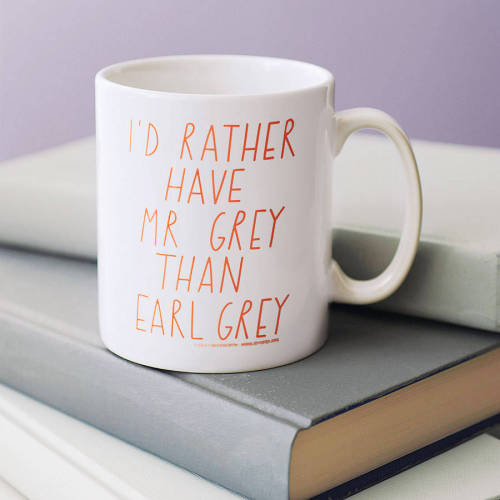
I can't even begin to tell you how WRONG this mug is...
 
You see, some (NOT ALL) of the people who agree with the message on that mug above, take their passion for the books a little too far.  Maybe they just love Mr Grey so much, they're blinded.  Or maybe they're just idiots.  You decide.  Here is a selection of some of the things I've had said to me on Twitter since I got involved in raising awareness of the abuse glorified in these books:
 
"If your ex was really like Christian Grey, you're obviously just not good enough for him.  LOL."
 
"Fuck off, you pathetic bitch.  You don't even understand BDSM!"
(DISCLAIMER: I have NEVER suggested that BDSM is abuse, but thanks for your ignorance!)
 
"LOL, pathetic.  Someone needs Mr Grey's twitching palm to sort her the fuck out."
 
Depressingly, not one of those tweets (and there were many more like them) was even attempting to start a discussion.  Not one was particularly civil.  But none frightened me.  None really upset me for long.
 
Then along came someone a little different.  Someone who took her obsession with being right about these books too far.  Someone who, in a worryingly common incident these days, decided that offensive language and threats of violence were the way forwards.
 
When a friend, @sageling, tweeted back to her, trying to defend the viewpoint that the books glamorise abuse, she told him to stop talking like that "for your own safety."  Thus implying that if he didn't stop, something bad would happen.
 
When she believed he'd misquoted or misunderstood her, she replied: "Stop twisting my words or I'll twist your neck." 
 
Later, when I - calmly and rationally - explained that when you've experienced abuse, you see it where perhaps others can't, she told me: "Like I give a flying fuck what you've experienced.  Hit the bricks, bitch."
 
But they've done nothing to deserve it!
 
Now, I like to think I can let a lot go over my head.  But in my eyes, this was threatening behaviour, pure and simple.  Threats of violence shouldn't simply be ignored, as far as I'm concerned.  So I - and others - reported this particular person to Twitter.
 
This whole thing happened at least a month ago.  This morning, I finally had a reply.  And it said:
 
"While we understand your frustration, the reported behaviour is not in violation of the Twitter Rules... As a policy, we do not mediate content and we do not intervene in disputes between users. This means that users are allowed to post potentially inflammatory content, provided that they do not violate the Twitter Rules."
 
All of which is rather interesting, seeing as the Twitter rules state:
 
"Violence and Threats: You may not publish or post direct, specific threats of violence against others."


"Stop twisting my words or I'll twist your neck."
 
"For your own safety... Stop talking about this."
 
Call me mad, but... Am I alone in seeing a specific threat of violence, there?!
 
I would possibly expect such a "oh please don't get me involved, I'm not bothered" reaction from a small Internet group or forum.  Usually in those situations, those moderating the site aren't paid to do so and often cliques form.  Nobody wants to the bad guy when you're talking about a small, tightly knit Internet community. 
 
But Twitter isn't a small, tightly knit Internet community.  Yes, there are Twitter-cliques.  Yes, there are people who've formed close friendships through the network.  But Twitter is a site with millions of users.  Twitter makes millions.  Its 2012 projection was a whopping $260million.
 
Before I go on, let me explain that I am aware that having so many users makes it almost impossible to moderate what happens on a site like Twitter.  But that's why the system for reporting users exists.  When someone feels that they're being abused, bullied or threatened, there has to be a way for that person to access support.  To be on the receiving end of nastiness is bad enough, but to be told that no rules have been broken (in spite of the blatant breaking of the "no threatening violence" rule) simply makes the person receiving such vile tweets feel as though nobody is on their side.
 
I'm a big girl.  The Internet has dealt me far worse before and I'm sure it'll continue to do so. But what if I wasn't a 30yr old, who can probably push aside this sort of thing without too much worry?  What if I were a 12 year old girl, taking those threats seriously?  The emotional effect it could have on a younger, less savvy user, doesn't bear thinking about.
 
Yes, you can click the "block" button.  Lord knows, I've been pretty "block-happy" of late.  But the "hit the bricks, bitch" tweet actually managed to get through to me after I had blocked this particular user.  And, although it wasn't the case in this incident, who's to say the user wouldn't get their friends involved?  Again, imagine I was a younger, more naive Twitter member, who was inundated with this sort of nastiness?!  And all we get from Twitter as a response is: "Well, I'm sure it must be frustrating."
 
In case you think I'm overreacting, let me throw an additional detail into the mix...
 
I mentioned that another Twitter user, by the name of @Sageling, had been on the receiving end of threats from this person.  He also reported her.
 
TWITTER SUSPENDED HIS ACCOUNT.
 
Why?  Because he was deemed to be "sending unsolicited messages" via the site.  What was he doing?  He was using the #50shadesisabuse hashtag to try to explain his views on the books.  People were arguing with him (in some cases, violently) and he was politely replying.
 
So, casually threatening to twist someone's neck because you disagree with their opinion is completely acceptable to Twitter.  To raise awareness of domestic abuse - calmly and rationally - is not.
 
I'm all for free speech.  I think it's important for us all to have a platform from which to have our views heard.  But when you are the organisation providing that platform, it's my belief that you have a duty of care to those who use it.  And frankly, total inaction when it comes to bullying and harassment shows a lack of care on Twitter's part.
 
Where do we draw the line?  Is bullying really any less vicious or affecting just because it comes from behind a screen?  I know from personal experience that that's not the case. 
 
The Internet is a wonderful thing, which is available almost anywhere these days.  But in some ways, when it comes to cyber bullying, that's a bad thing.  When you're bullied at school, or in the work place, home becomes your sanctuary.  You return to your safe place and you can finally try to put any nasty words or horrible actions out of your mind. 
 
With Internet bullying, the abuse is happening anywhere.  Your safe place disappears, because the Internet is in your home.  The Internet is in your bedroom.  Your personal space is invaded.  That makes cyber bullying just as dangerous as any other kind.
 
I run a group on Facebook.  I have a zero tolerance approach to bullying.  If I spot one user abusing another, they get a warning.  If they re-offend, they're banned.  Simple as that.
 
If we start from grass roots - the Facebook groups, the small Internet forums - then perhaps the larger social networking sites might follow.  Threatening violence is never acceptable.
 
I have replied to Twitter's email.
 
I await their response.


Monday, 4 February 2013

I Love You, BUT...

So last night, the ever-brilliant Jenny Trout (@Jenny_Trout - if you don't follow her on Twitter, WHY NOT?!) set a challenge to blog writers.  To show the fans of 50 Shades of Grey (and of course, EL James herself) that it's possible to do so, we are to talk about something we love, but which we know is problematic.  I.E. Something we think is great, but which we realise others could easily look at and say "WTF?!" about, much like many of us cannot fathom the appeal of a man like Christian Grey.  So in the interest of fair debate, I thought about whether there's anything I really love, that might be off-putting to others.  And I realised at first that my tastes are... Well, all a bit vanilla.

Yum.
 
In fact, I struggled to think of anything I really love that could genuinely be problematic for others.  Taste in film, music and books will always differ from person to person, after all.  But my love of Blur, for example, shouldn't really cause offence to anyone.  And focusing on bands, my love of the Manic Street Preachers simply couldn't offend, right?!
 
Well, maybe wrong.  Because as a Manics fan, I categorise myself as a "Richey girl."  And that, for some, has connotations.
 
For those not acquainted with the band, let me give you a quick music history lesson...
 
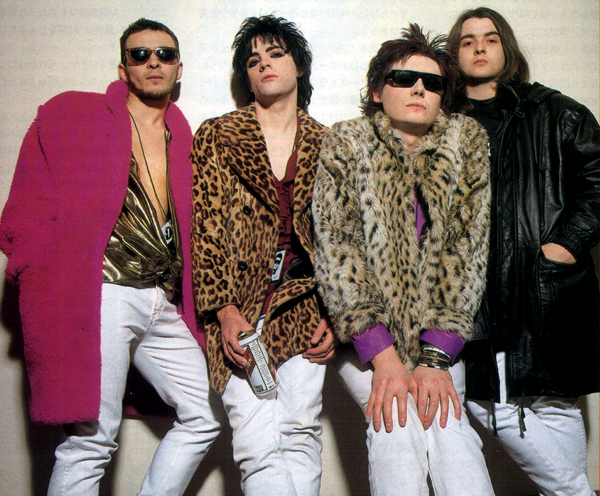
The Manic Street Preachers are a rock band from Wales.  They burst onto the music scene in the early 90's, clad in white jeans, frilly blouses with spray-painted slogans on, leopard print coats and feather boas.  They wore eyeliner.  They sang about politics and they said they wanted to sell sixteen million copies of their debut double album and then split up in a blaze of glory.  They were like nothing else happening at the time and you either loved or hated them.
 
Love.
 
One of the members of the band, Richey Edwards (second from the left in the above picture) admitted that he couldn't really play his guitar and was often unplugged ,or at least had his amp turned down low on stage.  He was, however an incredibly gifted lyricist, tackling subjects as diverse as early 90's pop culture and the holocaust with equal poetry.  he was also the band's mouthpiece; doing more interviews than anyone else, preaching the Manics' own gospel and personally contacting journalists to ensure the band got the press attention he believed they deserved.  
 
His was also, however, deeply troubled.  A virgin until 21, he was - in spite of his eye-catching dress and tenacity when it came to band promotion - deeply insecure and shy.  Crippling depression led to self-harm and an addiction to alcohol.  As the band gained fame and success, Richey's demons took him to the brink.  Borderline anorexia, alcoholism and depression led him to be admitted to The Priory clinic in 1994.  The band's album from the same year, The Holy Bible, contained lyrics that now seem to provide a worrying glimpse into an increasingly fragile mind.  In their last concert of the year, the band smashed all of their equipment and Richey, looking frighteningly gaunt, smashed himself in the forehead with his broken guitar, over and over whilst staring vacantly into space, before leaving the stage for the final time.
 
On February 1st 1995, Richey was due to fly to the USA with the Manics' lead singer, James Dean Bradfield for a promotional tour.  They stayed at The Embassy Hotel in London the night before, sleeping in adjoining rooms.  When Richey failed to meet his bandmate in reception on the morning of February 1st, James headed up to his room.  Richey was gone.  He had left behind a box, containing letters and gifts for a girl known only as "Jo."  A toll receipt found in his flat in Cardiff proved that he had headed back there from London, but there was no sign of him.  Two weeks later, his car was found at a service station close to the Severn Bridge.  The battery was flat and there was evidence that it had been lived in.  Despite extensive appeals, "sightings" and police searches, Richey Edwards was never found.  In November 2008, his family took the decision to declare him legally "presumed dead" and the police "missing" file was officially closed.
 
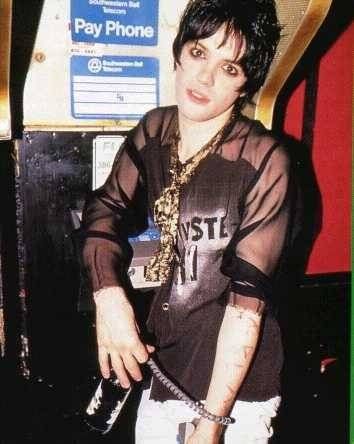
The last known picture of Richey Edwards.


So why could being a self-confessed "Richey-phile" be problematic?  Surely he's just a troubled rock star, with a mysterious disappearance that still leads to the odd "sighting" in all corners of the globe?  Well yes.  And no...
 
Manics fans are notoriously precious about "their" band and speaking as one, I know that to speak ill of Richey is, to some, almost blasphemous.  I have, for years, referred to Richey Edwards as something of a hero of mine and I shall explain why later, but this blog is meant to be about admitting that you like something that could be problematic, so let's tackle that part first and hope not to incur the wrath of my fellow fans.
 
Although writers such as Caitlin Moran described Richey as "a cause celebre among depressives, alcoholics, anorexics and self-mutilators, because he was the first person in the public eye to talk openly about these subjects; not with swaggering bravado and a subtext of "look how tortured and cool I am", but with humility, sense and, often, bleak humour," there were - and are - many detractors.  And with some reason.
 
Richey was notorious for wanting to make a "statement."  He once gave an interview to teen magazine Smash Hits, in which he told the young readership: "Don't do it, kids.  Don't get past 13."  In the early days of the band, when then NME journalist Steve Lamacq asked Richey whether people would believe that the band were "for real," Richey took out a razor blade and carved "4 REAL" into his arm.  He then posed for photos of the wounds, which inevitably ended up in newspapers and magazines, gaining him enormous notoriety.  The injury required more than a dozen stitches, but Richey didn't seem particularly bothered about whether his actions might influence some of the band's young fans.
 
Indeed,the band's followers, whether "inspired" by Richey, or simply because he, as a rock star, had made them feel better about what they were already doing, began appearing at gigs with self-imposed scars adorning their bodies.  A so-called "Cult of Richey" formed, with fans copying Richey's look; daubing on the eyeliner and making homemade t-shirts to wear to concerts.  These obsessive fans began referring to Richey as their idol; suggesting that only he understood them. They viewed him as "purity itself" thanks to his outspoken pro-feminist views and vulnerability. Anorexia being a predominantly female illness, girls began being drawn to Richey as they felt he shared their pains.  Seeing him as something of a tortured poet, these followers wouldn't hear a word against Richey or his behaviour.
 
Richey with "4 REAL" scars on display.
 
Although it would be unfair to suggest that Richey actively encouraged this entourage of copycat self-harmers and adoring fans, it would be deeply naive to suggest that he was unaware of it, or that he actively discouraged them, either.  In fact, Richey developed a rather unnerving habit of slashing open his chest at gigs (so much so that a fan once presented him with a knife before a concert and told him "look at me when you do it") and of taking advantage of these girls, by using them as his groupies.
 
The Manics have long attracted a band of fans who feel that they are, for many reasons "outsiders" and therefore, Richey's groupies were frequently wide-eyed, adoring girls, sometimes suffering from their own depression, which made them doubly vulnerable. 
 
Whilst on tour in Bangkok, it's no secret that Richey used the services of a prostitute, despite having earlier written the song Little Baby Nothing as a feminist rant against those who do.
 
By the time the Manics recorded what is still considered by many to be their masterpiece, 1994's The Holy Bible, Richey had almost entirely gone off the rails.  He was, by this point, drinking a bottle of vodka a day and scouring the post-gig autograph hunters for a fan to sleep with.  He'd give interviews to the press, describing sex as being something he didn't even enjoy ("nature's lukewarm pleasure") and which made him feel used.  His slide deeper into depression led him to confess to not wanting to go on stage.  In November of 1994, Richey purchased a meat cleaver, supposedly so that he could cut his own fingers off, in order to have an excuse not play guitar at concerts anymore.  In early December, the band's European tour was curtailed early, after bassist Nicky wire discovered his childhood best friend sitting outside the band's hotel, hitting his head against the wall, over and over, until blood streamed down his face. 
 
On The Holy Bible, the lyrics sometimes make for uncomfortable listening.  From lines on self-harm, to anorexia, the album isn't exactly the kind of music you'd play in the background at a dinner party.  Richey was, by this point, steering the band to a dark place.  Musically and in his own personal life.
 
The "Richey-phile" stereotype is of a person who loves Richey so unquestionably, that they refute any question of his glorifying self-abuse by cutting himself so publicly.  They will not tolerate talk of Richey's vulnerable groupies and the troubling "cult" that he passively allowed to grow up around him.
 
I am not one of those "Richey-philes."  I can fully accept that my love of this deeply troubled man, could be considered unacceptable by some.  That he could be viewed as a very bad role model.  I'm  inclined to agree to a point.
 
BUT...
 
Richey remains a man I admire in many ways.   I welcome debate on his behaviour and I'm not blind to his faults, but those who say "oh God, he was a selfish, attention-seeking drama queen who obviously killed himself, thus causing his family and friends unimaginable pain," will not change my mind.
 
I do hate him for having better eye make up than I ever have, though.
 
So why do I love him?  To answer that, we have to go back to that Caitlin Moran quote from earlier.  Because for all his flawed behaviour, Richey really was the first celebrity (or one of them) to openly talk about depression and self-harm in an honest, humble manner.  He may have cut himself on stage, but he didn't attempt to make light of it in the press.  He talked about self-harm as his only release for the pain he felt internally:"I'm not a person who can scream and shout so this is my only outlet."  And whether he meant to influence an entire sub-culture of fans or not, his honesty did help countless youngsters who were dealing with the same issues and who felt incredibly alone.  The dangerous hero-worship that followed is not something to admire Richey for, but then I disagree with anyone who suggests he created it through his own actions - at least not willingly.  Upon being handed the knife I mentioned earlier, by the fan who asked him to look at her whilst he cut himself, Richey was said by his fellow bandmates to be appalled and felt his depression was being trivialised and turned into something he felt deeply uncomfortable about.  Whilst his ego was stroked by his army of fans, Richey was not about to willingly become their God.  He spoke often of simply wanting to "get better."  His searing honesty about depression, alcohol abuse and self-harm encouraged others to open up about their own problems - indeed, weekly music magazines at the time received endless letters from teenagers who had previously thought they were alone in dealing with their issues.  Who said that if someone as well known and successful as Richey could suffer, then clearly anyone could, but if he was battling his demons, they'd find the strength to do so, too.
 
Also, I am a writer.  I struggle for pretty metaphors and flowery language at times, but to Richey, it came as naturally as the changes in the season (see what I mean about the metaphors?!).  That he could turn a subject as horrific as the ravages of anorexia into deeply moving poetry ("I want to walk in the snow and not leave a footprint") is a sign of his enormous intellect - for Richey is acknowledged by all to have been a man of huge academic intelligence, if not emotional.  People criticise Sylvia Plath's poetry for being "too depressing" (and unsurprisingly, Richey was a big fan), but I have always loved her rawness and her refusal to sugar-coat issues.  Richey was similarly passionate and direct in his words.  "If you stand up like a nail, then you will be knocked down. I've been too honest with myself, I should have lied like everybody else" (from "Faster") remains one of my favourite lyrics of all time.  They're raw.  They're not trying to say "oh yeah, I'm fine, tra la la," they're admitting to some pretty intense stuff going on in the writer's head.  To me, that ability to put something horrendous into such beautiful prose, is worthy of tremendous admiration.
 
Richey was a man with deep, deep flaws.  But he didn't hide from them.  He spoke out about them and he challenged people's perceptions in many ways.  He used his position as joint lyricist within the band to write songs that tackled subjects that would have other bands running scared and in doing so, he helped cement the Manic Street Preachers' position as one of the most important bands of the late 20th century. To this day, in spite of the fact that Manics have continued for 18 years without him and have released other material, with some excellent lyrics (I have a Manics tattoo with the words "This world will not impose its will, I will not give up and I will not give in" on my back, as the lyrics genuinely helped me move on from my abusive relationship), it is to Richey's words that generation after generation of teens head when looking for someone they can identify with. Why? Because nobody has articulated the pain of depression, the agony of self-harm or the feeling of helplessness better in lyric form than Richey James Edwards. I was one of those teens. I sought comfort in knowing I wasn't alone. And I can't forget that. I thank Richey for his words.
 
I'm not going to suggest that Richey's use of vulnerable young fans as groupies is okay.  It wasn't and he should have known better.  But I'm also not going to presume any knowledge as to what was going through his mind back then, because a) I wasn't there and b) Richey was going through such an intense depression and struggling with such addiction that I'm not sure even he knew what was going through his mind, let alone a fan, writing about it 18+ years later.  So I don't excuse his behaviour outright and I fully accept criticism of it, because I can see that there's a big problem with a celebrity sleeping with troubled young fans on a regular basis, but neither can I out and out condemn him, because there is no question of him ever using force or deliberately harming anyone other than himself.  I am able to separate the reality of his questionable behaviour off-stage from the equal reality of his incredible gift as a writer, his awareness-raising on the subject of depression and his part in ensuring the success of my favourite band of all time.  I do not blindly hero-worship Richey Edwards and I understand and listen to the opinions of those who criticise him.
 
I will, though, remain a fan.